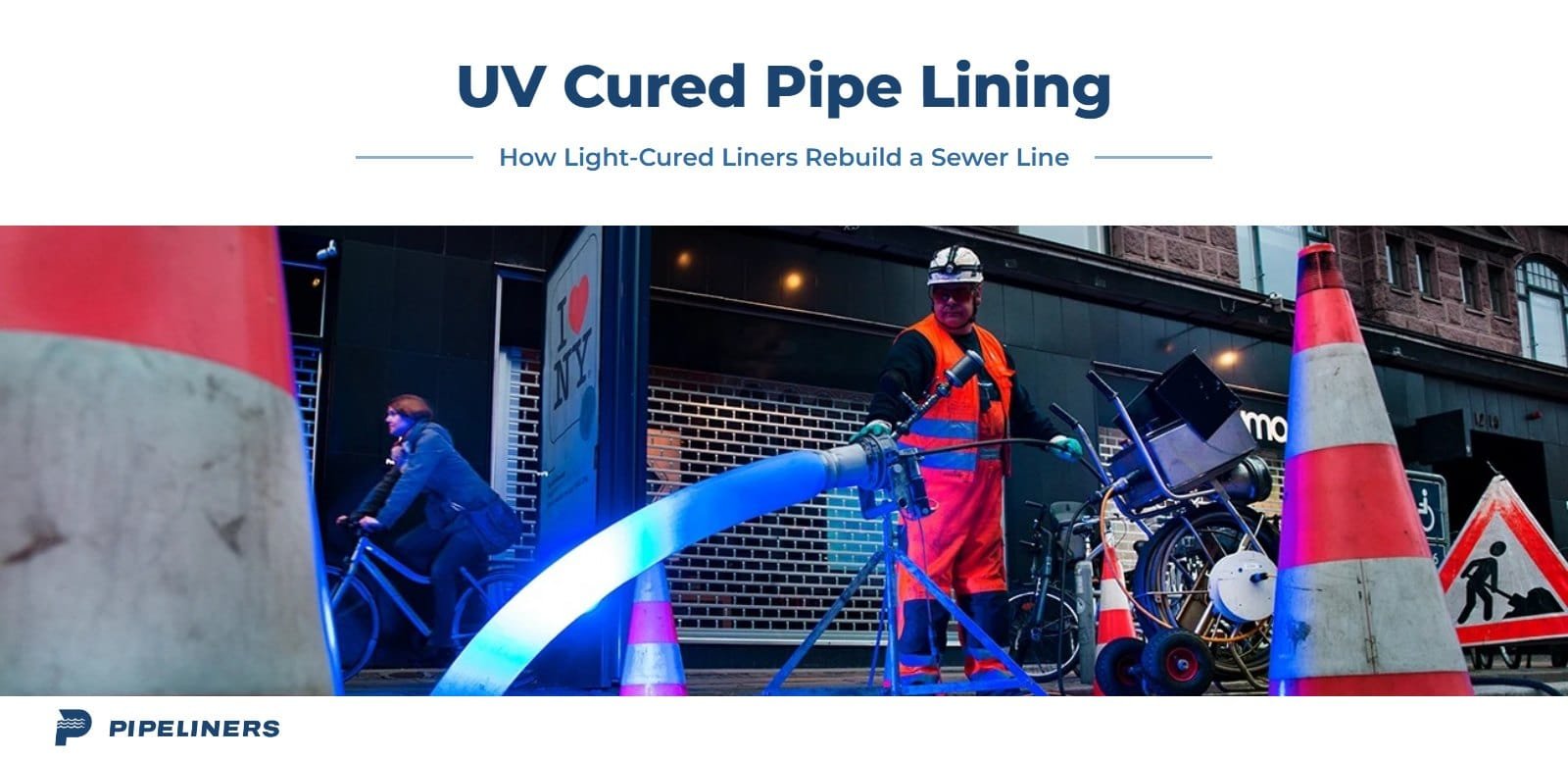

Quick answer: UV cured pipe lining is a no-dig sewer repair method that uses ultraviolet light, instead of heat, to harden a new liner inside your existing pipe. A resin-saturated liner is pulled into the damaged line, inflated against the pipe walls, and cured by a light train that travels through it. When the light passes, the resin sets.
In short: you get a new, seamless pipe inside the old one, and no trench across your property.
The alternative is curing with heat, usually steam or hot water. Both approaches build a structural liner. They differ in how the resin is hardened, and that difference has practical consequences for the job in your yard.
Key takeaways
- UV cured pipe lining hardens the resin with ultraviolet or LED light rather than steam or hot water.
- It is a recognized method within cured-in-place pipe (CIPP) lining, not a separate technology.
- UV systems typically use glass-reinforced liners, specified under their own ASTM standard.
- The cure is monitored in real time as the light train travels the pipe.
- It cannot fix a collapsed line or correct a bellied section, which is why the camera inspection comes first.
What does UV cured pipe lining actually do?
It hardens the resin using light instead of temperature.
A conventional liner cures because heat is introduced into the pipe and the resin reacts to it. A UV liner carries a resin that reacts to light instead. A carriage holding UV or LED lamps is drawn through the inflated liner at a controlled speed, and the resin sets as the light passes over it.
This is not a fringe method. NASSCO, the industry body for trenchless rehabilitation, describes cured-in-place liners as being set under ambient conditions, by applying a heat source, or through a photoinitiated reaction by exposure to UV or LED light. All three are standard. NASSCO’s 2025 rehabilitation matrix lists glass-reinforced, UV-cured installation under its own ASTM standard, F2019, with its own minimum strength requirements, separate from the standards covering the felt-and-steam systems most people picture when they hear about lining.
If the term cured-in-place pipe is new to you, our guide to how CIPP lining works covers the fundamentals. UV curing is one method within that family, not a different technology.
UV curing vs steam curing: what is the difference?
Both produce a structural pipe inside your old one. Here is where they diverge.
| UV cured lining | Steam or hot-water cured lining | |
|---|---|---|
| What sets the resin | Ultraviolet or LED light | Heat, applied as steam or circulated hot water |
| Liner material | Typically glass-reinforced | Typically felt, or fiber-reinforced felt |
| ASTM standard | F2019 | F1216 (inversion), F1743 (pulled-in-place) |
| On-site equipment | Generator, control unit, air compressor | Boiler or steam rig, plus hoses to move heat |
| Cure monitoring | Camera on the light train, watched in real time | Temperature readings held across the run |
| Best suited to | Pipes that hold their shape, long or awkward runs | A wide range of diameters and shapes |
Neither column is the “better” one. Pipe condition, diameter, bends, and access decide the method, and that decision comes from a camera inspection rather than a preference.
Why does the curing method matter to a homeowner?
Because it changes what happens on your property while the work is going on.
Control. A light train moves at a set speed with a camera riding along it, so the cure is watched as it happens rather than inferred from a temperature holding steady somewhere along the run. If something is off, it shows up while the crew can still act on it.
Different equipment footprint. Steam curing needs a rig to generate heat and hoses to move it. UV curing swaps that for a generator and a control unit, which is generally less bulk staged on the driveway. On a large lot with a long access route, that matters more than it sounds.
Liner material. UV systems commonly use glass-reinforced liners rather than the felt tubes used in steam-cured work. It is a different material class, specified under a different standard, with its own minimum strength requirements.
How does a UV cured in place pipe job actually run?
Four stages, in order.
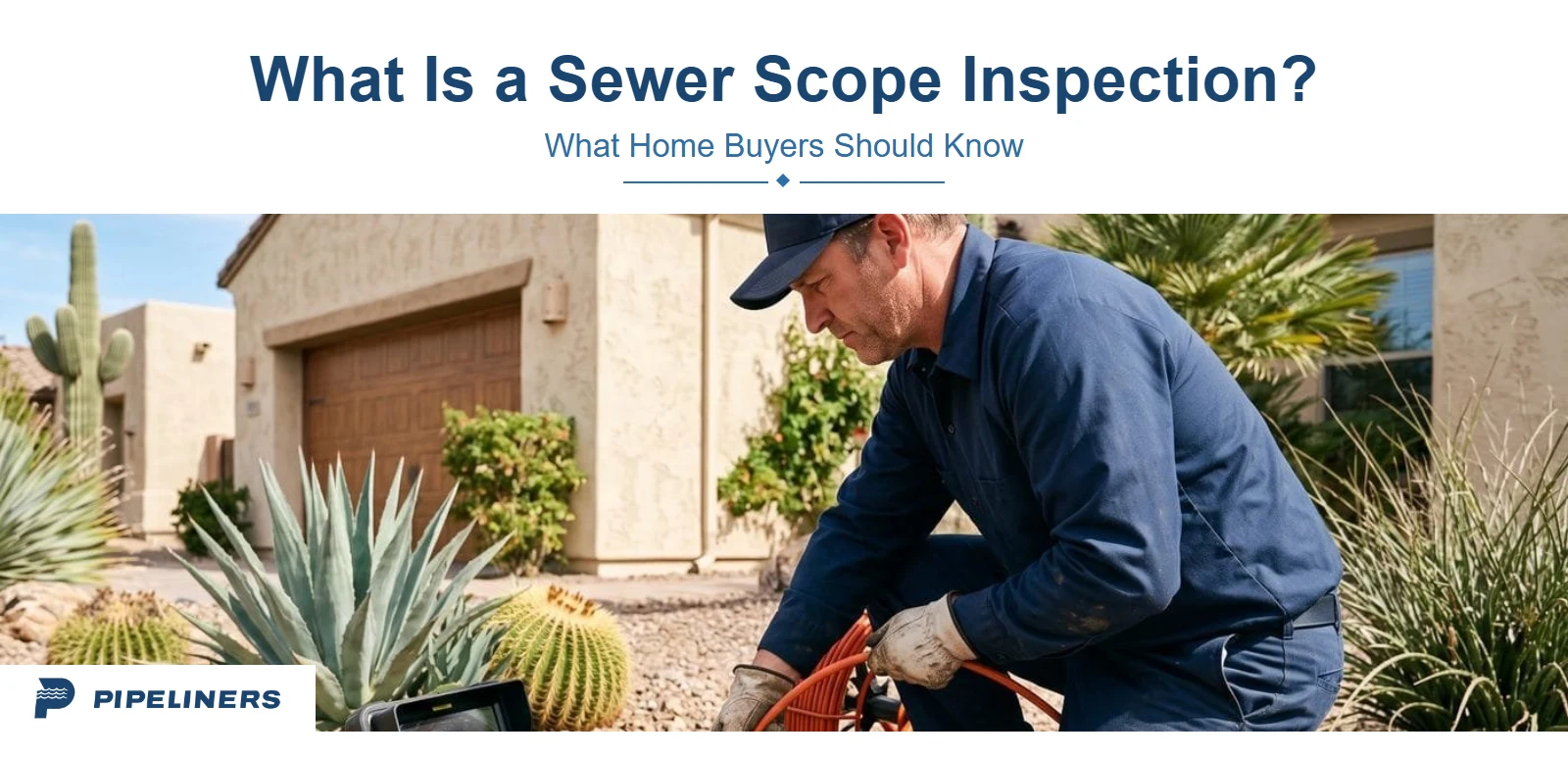
1. Camera inspection. The line gets scoped first. This confirms the pipe holds enough shape to line, locates the damage, and measures the run. Any contractor quoting a liner without inspecting the pipe is guessing.
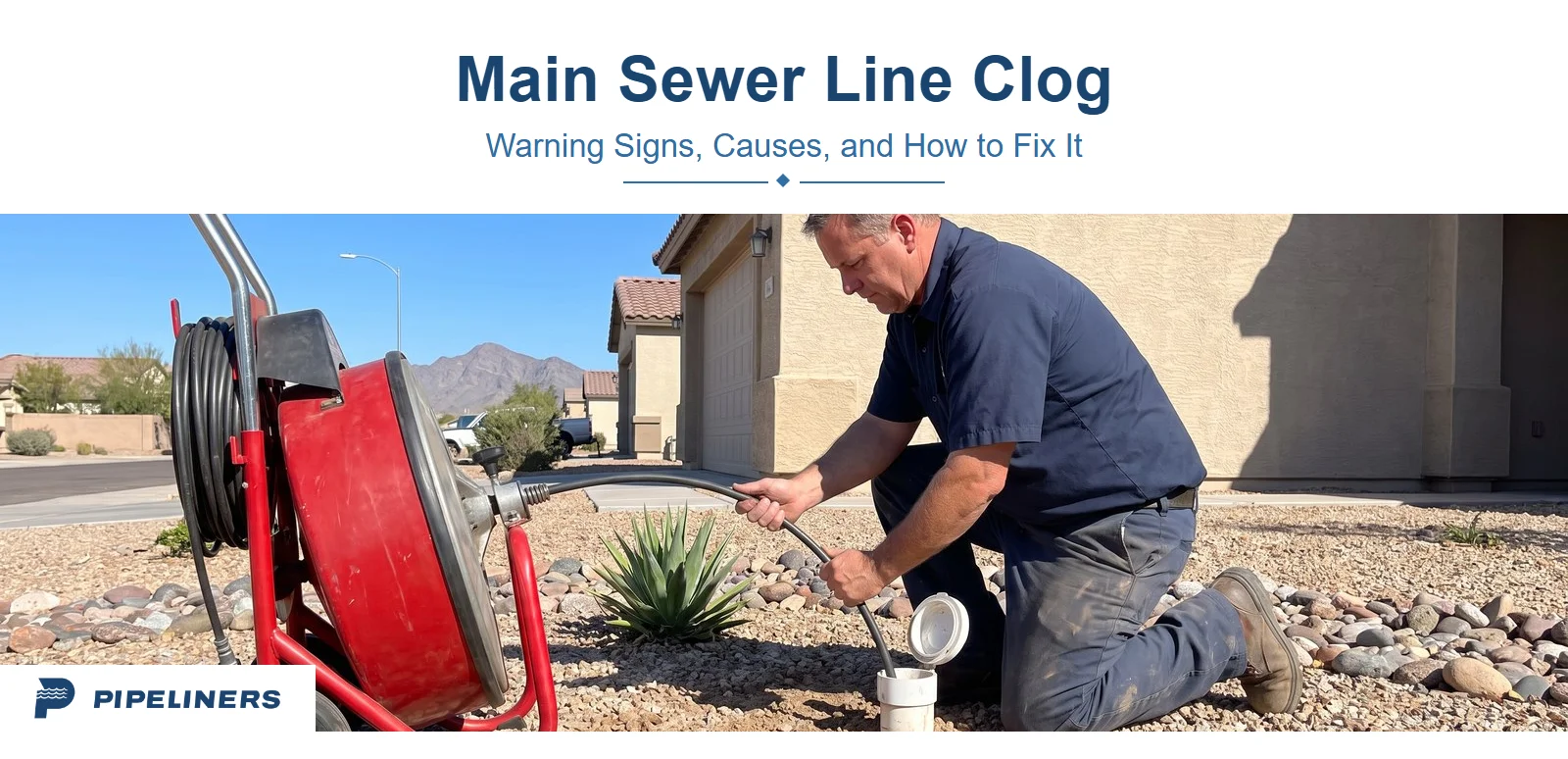
2. Cleaning. Roots, scale, and buildup come out, usually with hydro jetting. The liner has to press against a clean host pipe. This step is skipped more often than it should be, and it is where bad lining jobs start.
3. Liner installation. The resin-saturated liner is drawn into place and inflated so it sits firmly against the pipe wall.
4. Curing and final inspection. The light train is pulled through at a controlled rate. Once the resin has set, a second camera pass confirms the finished liner before the crew packs up.
That last camera pass is the part to insist on. It is the difference between being told the work went well and seeing that it did.
Where does UV lining fit in the Phoenix Valley?
The longer the sewer run, the more the no-dig approach is worth.
On a standard Phoenix lot, a failed sewer line means a trench across a front yard, which is what trenchless sewer repair in Phoenix avoids. On the larger parcels common around Fort McDowell, Rio Verde, and the northeast Valley, the run from the house to the connection can be considerably longer, and it often crosses driveways, gravel, and mature desert landscaping. Excavation cost and disruption scale with that distance. Lining does not, because the work happens through access points rather than along the whole length.
Desert conditions add their own pressure. Mature mesquite and palo verde send roots a long way looking for water, and a leaking joint in a dry yard is one of the few reliable water sources available. Once roots find a separation, they widen it.
We work across the Valley, and on the larger properties our pages on trenchless sewer repair in Fort McDowell, pipe repair in Rio Verde, and sewer services in Fountain Hills cover what we do in each area.
When is lining not the answer?
Lining rebuilds a pipe. It does not reposition one.
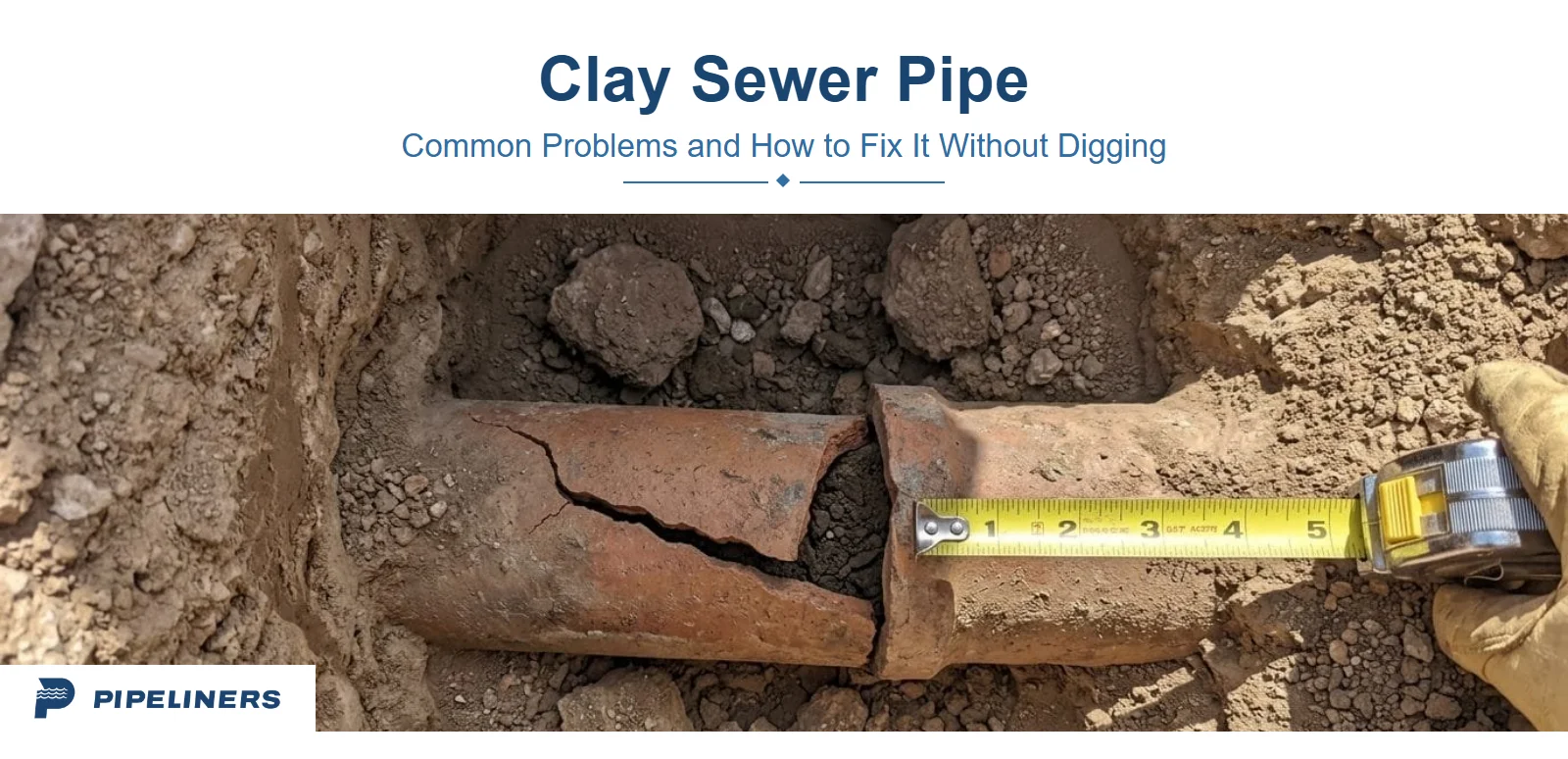
- A collapsed line has no shape left to line against. That needs excavation. Our guide to cracked vs collapsed sewer pipes explains how to tell them apart.
- A bellied or back-pitched section holds standing water because the pipe has settled. A liner follows the existing grade, so it preserves the sag rather than correcting it. Here is what a bellied sewer pipe is and why Valley soil causes it.
- Badly misaligned joints may not accept a liner cleanly.
This is the honest limit of the method, and it is another reason the camera inspection is not optional. Our trenchless drain and sewer repair service starts there for exactly this reason.
Frequently asked questions
Is UV cured pipe lining available in the Phoenix area?
Yes. We work throughout the Valley, including Phoenix, Mesa, Fountain Hills, and the rural parcels around Fort McDowell and Rio Verde. The method is chosen based on what the camera inspection finds, not on location.
How is UV curing different from the steam curing I have been quoted elsewhere?
Both produce a structural liner. UV uses light to set the resin and is usually paired with glass-reinforced liners; steam uses heat and is usually paired with felt. The right one depends on your pipe, not on which sounds more advanced.
Will a UV liner work on the long sewer runs common on large desert properties?
Length is usually manageable. What matters more is the pipe’s condition along that run and whether there is workable access at each end. A camera inspection answers both before anything is committed to.
Does UV lining handle the root intrusion we get from desert trees?
Sealing the joints and cracks removes the openings roots grow through. Roots follow moisture, so once the leak is sealed, that section stops attracting them. Existing roots are cleared during the cleaning stage.
Do I need a camera inspection first, even if I already know where the problem is?
Yes. Knowing where a backup happens is not the same as knowing the pipe’s condition, and lining cannot correct a collapse or a bellied section. The inspection rules those out.
Is UV cured pipe lining the same as CIPP?
It is one type of CIPP. Cured-in-place pipe is the broad family; UV curing is one of the three recognized ways to set the resin, alongside ambient curing and heat curing.
Ready to find out what your sewer line actually needs?
Every lining job here starts the same way, with a camera in the pipe and a clear picture of what is going on. Schedule a sewer camera inspection with Pipeliners USA and we will tell you whether UV lining fits your line, whether another method is the better call, or whether the pipe needs to come out.