
Quick answer: Trenchless sewer repair is a way to fix or replace a broken sewer line without digging up your whole yard. Crews access the pipe through one or two small points, then either line the old pipe from the inside or pull a new pipe through the old one. It is faster and far less messy than the old dig-and-replace method, and in most cases it costs less once you add up cleanup and landscaping.
Key Takeaways
- Trenchless sewer repair fixes underground pipes with little or no digging, using small access points instead of a long open trench.
- The two main methods are CIPP lining (cured-in-place pipe, a new pipe formed inside the old one) and pipe bursting (the old pipe is broken apart while a new pipe is pulled in).
- It usually means less yard damage, faster work, and lower total cost than traditional excavation.
- A trenchless lining from Pipeliners USA carries a 50+ year life expectancy and a 20-year transferable warranty.
- Some situations, like a fully collapsed or badly misaligned pipe, still call for a traditional dig.
What is trenchless sewer repair?
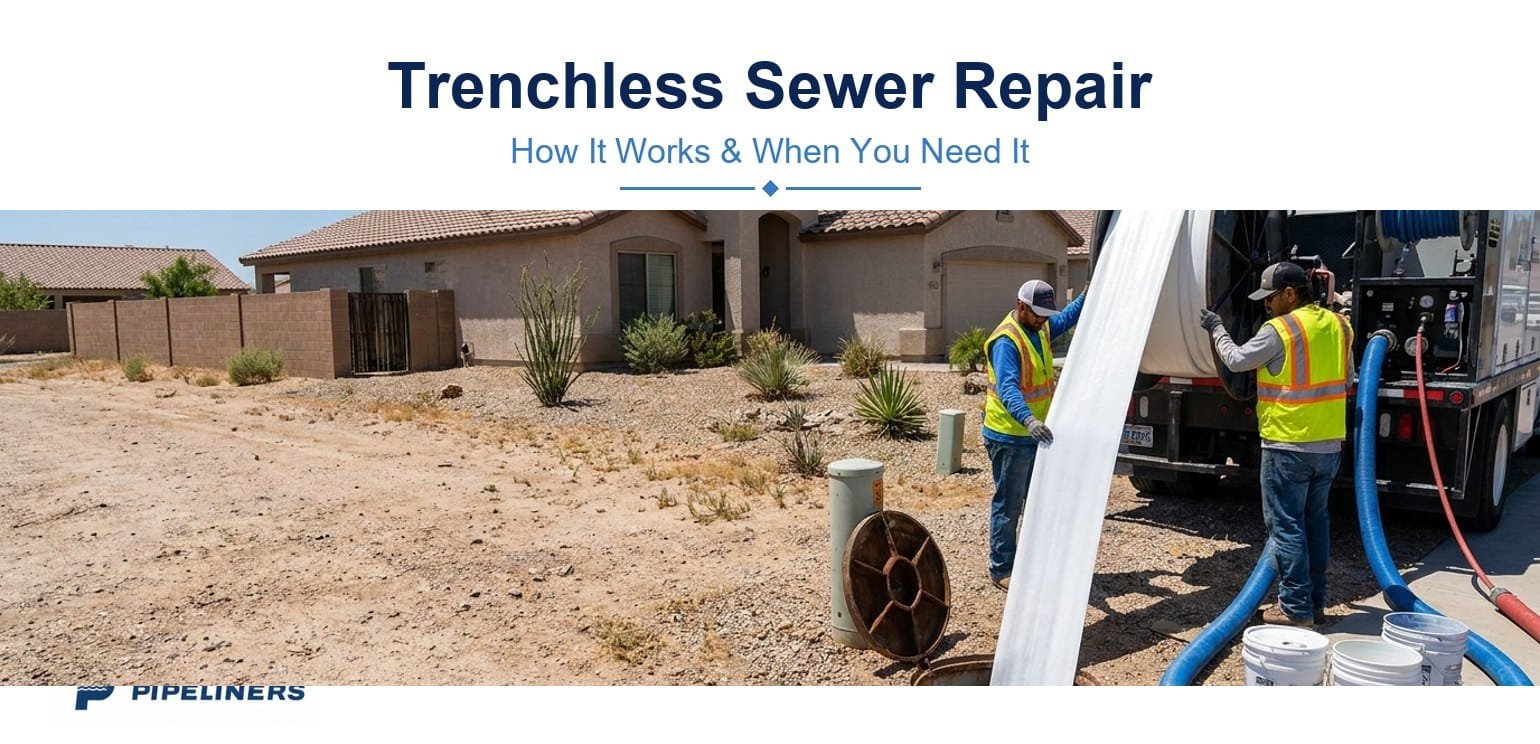
Trenchless sewer repair is a no-dig method for fixing damaged sewer and drain pipes from the inside or by replacing them through small access points. Instead of tearing open your lawn, driveway, or floor, crews work through an existing cleanout or one or two small holes.
The repair happens underground, so the surface above stays mostly untouched. That is the whole point. You get a working pipe again without losing your landscaping, patio, or concrete.
This approach has grown fast for good reason. According to the U.S. Environmental Protection Agency, trenchless rehabilitation now makes up a rising share of what the country spends to maintain its water and sewer systems, and cured-in-place lining is the most commonly used technique.
How does trenchless sewer repair work?
Trenchless sewer repair works by first inspecting the pipe with a camera, then choosing a lining or replacement method that fits the damage. The crew preps the line, installs the fix through small access points, and confirms the result with a second camera pass.
Here is the basic process most jobs follow:
- Camera inspection. A small waterproof camera is sent down the line to find cracks, roots, bellies, or breaks.
- Cleaning. The pipe is cleared of roots, grease, and scale so the new lining or pipe can seat properly.
- Repair. The crew lines the pipe (CIPP) or pulls a new pipe through it (pipe bursting).
- Curing or setting. A liner is hardened in place; a new pipe is connected and checked.
- Final camera check. One more camera pass confirms the pipe is smooth, sealed, and flowing.
Most residential jobs are finished in a day or two, though curing time and pipe length can change that.
What are the main trenchless methods?
The two main trenchless methods are CIPP lining and pipe bursting. CIPP rebuilds the pipe from the inside, while pipe bursting replaces it entirely. The right choice depends on the condition of your existing line.
CIPP lining (cured-in-place pipe)
CIPP lining, short for cured-in-place pipe, creates a brand-new pipe inside your old one. A soft tube soaked in resin is pushed or inflated into the damaged pipe, then hardened so it sets against the old walls. When it cures, you have a smooth, seamless, joint-free pipe with no gaps for roots to sneak through.
CIPP is a great fit when the existing pipe is cracked or leaking but still holds its basic shape. To go deeper on how the resin and curing work, see our guide on what CIPP is.
Pipe bursting
Pipe bursting fully replaces the old line. A cone-shaped bursting head is pulled through the existing pipe, breaking it apart while it drags a new pipe in behind it. The old pipe becomes scrap in the ground, and you end up with a completely new line.
This method shines when the old pipe is too far gone to line, such as a badly corroded or partly collapsed line. For a side-by-side look at every option, including spot repairs and epoxy coatings, read our overview of pipelining methods in Phoenix.
Epoxy coating for smaller supply pipes
For thinner water supply lines with pinhole leaks or low flow, an internal epoxy coating can restore the pipe by sealing it from the inside. This is a different tool for a different problem, and you can learn more on our ePIPE restoration page.
Trenchless sewer repair vs traditional dig: how do they compare?
The simplest difference is the mess. Traditional repair opens a long trench across your property, while trenchless work uses small access points. The table below breaks down the practical trade-offs.
| Factor | Trenchless Sewer Repair | Traditional Dig and Replace |
|---|---|---|
| Digging | Little to none; small access points | Long open trench across the yard |
| Yard and concrete damage | Minimal | Often heavy; lawn, driveway, or floor torn up |
| Time on site | Often 1 to 2 days | Several days to weeks |
| Cleanup and restoration | Low | High; landscaping and concrete to redo |
| Total cost | Usually lower once cleanup is counted | Often higher after restoration |
| Best for | Cracked, leaking, or worn pipes | Fully collapsed or severely misaligned pipes |
What are the pros and cons of trenchless sewer repair?
The main advantage of trenchless sewer repair is that it fixes your pipe without destroying your property, but it is not the right answer for every pipe. Here is a balanced look.
Pros:
- Little to no digging, so your yard, driveway, and floors stay intact.
- Faster than traditional repair, often done in a day or two.
- A seamless liner blocks tree roots and stops future leaks.
- Lower total cost once you factor in cleanup and landscaping.
- Long-lasting; lined pipes are built to last for decades.
Cons:
- It will not work on a pipe that has fully collapsed or lost its path.
- Severe misalignment or major sag (a “belly”) may still need a dig.
- It requires trained crews and specialized equipment, so it is not a DIY job.
What affects the cost of trenchless sewer repair?
The cost of trenchless sewer repair depends mostly on the length of the pipe, how deep it sits, the method used, and how much access the crew has. A short, shallow line is far cheaper to fix than a long line buried under a driveway.
Common cost factors include:
- Pipe length and diameter. Longer and wider lines need more material and time.
- Depth and access. Deeper pipes and tight access points add labor.
- Method. Lining and bursting have different material and equipment needs.
- Pipe condition. Heavy root intrusion or scale means more cleaning first.
- Permits. Some cities require permits for sewer work.
Because every line is different, the only way to get a real number is an inspection. For an exact diagnosis, start with a free sewer inspection.
When does trenchless work and when is a dig still needed?
Trenchless sewer repair works whenever the existing pipe still has a clear, continuous path, even if it is cracked, leaking, or root-filled. A traditional dig is needed only when that path is gone, such as a collapsed pipe or a section that has shifted out of line.
A few Arizona realities make trenchless especially handy here. Older Phoenix-area homes often have aging clay or cast iron lines that crack with time. Hard water leaves scale that narrows pipes, and monsoon-season soil shifts can stress underground lines. Trenchless repair handles those wear-and-tear problems well without tearing up mature desert landscaping or hardscape.
If your pipe is truly collapsed or out of alignment, do not worry; the right repair will be clear after a camera inspection. When you are ready to fix the line, our trenchless drain pipe repair service walks you through the next steps.
Frequently asked questions about trenchless sewer repair
How long does trenchless sewer repair take?
Most residential trenchless sewer repairs are finished in one to two days. The exact time depends on the length of the pipe, the method used, and the curing time for a liner.
Is trenchless sewer repair cheaper than digging?
In most cases, yes, once you count cleanup. Trenchless work avoids the cost of redoing torn-up landscaping, driveways, and concrete, so the total bill is often lower than a traditional dig.
How long does a trenchless pipe last?
A trenchless lining from Pipeliners USA carries a 50+ year life expectancy and a 20-year transferable warranty. Independent EPA testing also found that cured-in-place liners are expected to last 50 years and possibly beyond.
Does trenchless sewer repair damage my yard?
Very little. Crews access the pipe through an existing cleanout or one or two small points, so your lawn, trees, and hardscape stay mostly untouched.
Can any sewer pipe be repaired with a trenchless method?
Not every one. Trenchless methods work when the pipe still has a continuous path, but a fully collapsed or badly misaligned line usually needs a traditional dig.
How do I know which trenchless method I need?
A camera inspection tells you. The crew looks at the condition and shape of your pipe, then recommends CIPP lining, pipe bursting, or another method based on what they find.
Ready to fix your sewer line the easy way?
Trenchless sewer repair lets you fix a broken line without the mess of a full dig, and it usually saves money once cleanup is counted. The first step is always a camera inspection so you know exactly what you are dealing with. Schedule a free sewer inspection with Pipeliners USA and get a clear answer for your home.