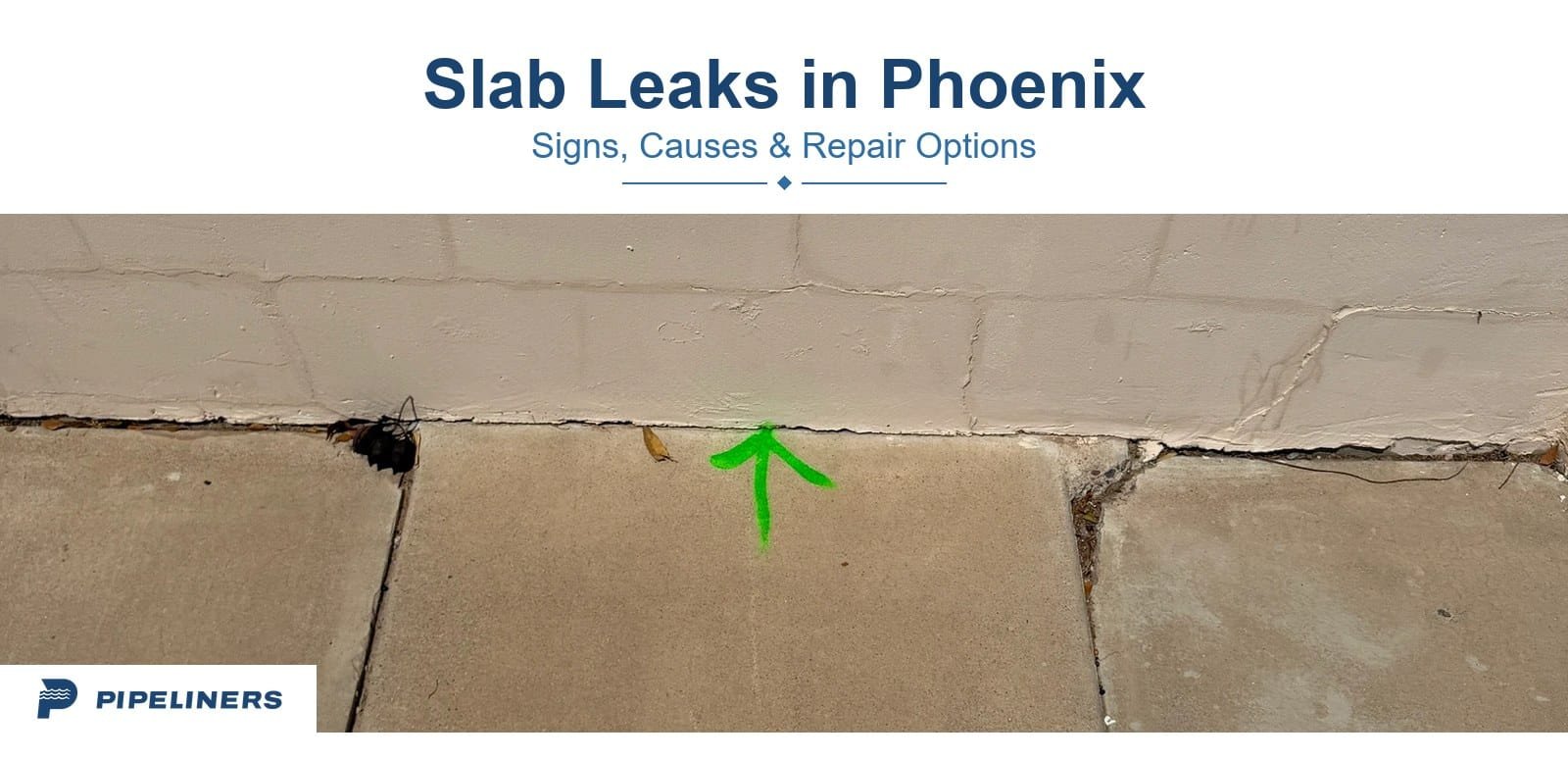

A slab leak is a leak in a water line running underneath your home’s concrete foundation. In the Phoenix Valley it is usually a copper supply line that has corroded from the inside until it opens a pinhole. The leak does not stop on its own, and because the pipe is buried in concrete, the damage is often well advanced before anyone notices it.
In short: breaking up your floor is only one of the ways to fix it, and often not the best one.
Key Takeaways
- A slab leak is under the foundation, not in the yard. That distinction changes the whole repair.
- The most common early signs are a warm spot on the floor, a running water sound with every tap off, and a water bill that climbs for no reason.
- Phoenix water is hard, and hard water is part of why copper supply lines here fail from the inside.
- Four repair paths exist, and only one of them requires opening the slab.
- Every honest repair starts with locating the leak precisely. Anyone quoting a fix without finding the leak first is guessing.
What is a slab leak?
Most homes in the Phoenix Valley are built slab on grade, meaning the house sits on a poured concrete pad rather than over a basement or crawlspace. The water lines that feed your fixtures often run through or beneath that pad.
When one of those buried lines develops a leak, it is called a slab leak. Water escapes under the concrete, where you cannot see it and cannot reach it without either opening the slab or working around it.
Two different systems can leak under a slab, and they behave differently:
- A pressurized water supply line. This is the classic slab leak. Because the line is under constant pressure, it leaks continuously, day and night, whether or not anyone is using water. This is what most of this article is about.
- A drain or sewer line under the slab. These are not pressurized, so they only leak when something drains. The symptoms are different, usually sewer odor or slow drains rather than a warm floor. That is a different repair, closer to our trenchless drain and sewer repair work.
If the leak is out in the yard between the meter and the house rather than under the foundation, the signs overlap but the fix is simpler. Our guide to finding an underground water leak covers that case.
What are the signs of a slab leak?
Slab leaks announce themselves indirectly. Watch for these.
A warm spot on the floor. This is the most specific sign there is. If a section of tile or laminate is noticeably warmer than the floor around it, a hot water line below is likely leaking. Hot water lines fail more often than cold ones because heat accelerates corrosion.
The sound of running water when everything is off. Turn off every fixture and appliance, then stand still in a quiet room. A faint hiss or trickle with nothing running points at a pressurized line losing water somewhere.
A water bill that climbs with no change in habits. A pinhole leaking continuously adds up. A bill that rises month over month while your usage stays flat is worth investigating.
Low water pressure. Water escaping under the slab is water not reaching your fixtures.
Cracked or lifting flooring. Water under a slab saturates the soil beneath it. As that soil swells and shifts, tile can crack and grout lines can open.
A musty smell, or mold along baseboards. Moisture wicking up through the slab into carpet, baseboards, or drywall creates conditions for mold well before you see standing water.
The meter test. Turn off every water fixture in the house, then look at your water meter. If the low flow indicator is still turning, water is moving somewhere it should not be. This is the single most useful check a homeowner can run without tools, and it is worth doing before you call anyone.
One caution. None of these signs by itself proves a slab leak. A warm floor can be a heating element, and a high bill can be an irrigation problem. They are reasons to have the system checked, not a diagnosis.
Why do slab leaks happen so often in the Phoenix Valley?
Three factors stack up here.
The water is hard. The City of Phoenix 2025 Water Quality Report lists total hardness between 172 and 302 ppm, which is 10 to 17.6 grains per gallon. For scale, the USGS classifies anything above 180 mg/L as very hard. Much of the Valley’s supply sits at or above that line. Hard water leaves mineral scale inside copper pipe, and scale creates the uneven interior surface where localized corrosion takes hold.
The pipe is often copper, and copper fails from the inside. Copper supply lines corrode inward, thinning the wall at small points until one opens. That is why the failure shows up as a pinhole rather than a burst. We cover the chemistry in more detail in what causes pinhole leaks in copper pipes, and the broader pattern in our guide to corroded pipes.
The soil moves. Desert soils shrink when dry and swell when wet. Seasonal movement puts stress on rigid lines that are locked in concrete and cannot flex with it.
Put together, a copper system installed decades ago in a slab on grade home, carrying hard water, sitting in soil that moves seasonally, is a system with a predictable failure mode. Age matters more than anything else. If a house is old enough that its original supply lines are still in service, a slab leak is a question of when rather than if.
How is a slab leak located?
You cannot repair what you have not found, and on a slab leak the finding is most of the skill.
Locating is done without breaking concrete, using acoustic listening equipment that picks up the sound of pressurized water escaping, along with pressure testing to confirm which line is losing water and thermal imaging to trace hot water lines. The goal is to narrow the leak to a specific point rather than a general area, because the difference between a precise location and a rough one is the difference between a small opening and a large one.
This is why the inspection is not an upsell. A contractor who proposes a repair before locating the leak is proposing to guess where to break your floor. Our leak detection service in Phoenix starts here for that reason.
What are the repair options for a slab leak?
Four approaches, and they suit different situations.
| Option | What it involves | Best when | Trade-off |
|---|---|---|---|
| Spot repair | Open the slab at the leak, cut out the failed section, replace it | A single leak in a system that is otherwise sound | Opens your floor, and does nothing for the rest of the pipe |
| Reroute | Abandon the under slab line and run new pipe through walls or the attic | One or two leaks with an accessible route | Drywall and ceiling repair, and the old line stays abandoned in place |
| Whole house repipe | Replace all supply lines with new pipe | The system is failing in several places at once | The most disruptive and longest option |
| Epoxy restoration | Lining the pipe from the inside, no slab opened | Pinhole leaks from internal corrosion, pipe still structurally sound | Not an answer for a crushed or severely damaged line |
The first three all involve either breaking concrete or opening walls. The fourth does not, which is why it is worth understanding before you agree to a jackhammer. ePIPE epoxy restoration works by coating the inside of your existing copper lines, sealing pinholes and putting a barrier between the water and the corroded copper. Because the work happens inside the pipe, the slab stays closed and the walls stay intact.
When lining the pipe is not the answer
Lining the pipe rebuilds it from the inside. It does not replace a pipe that has lost its structure.
- A line that is crushed, split, or badly damaged has nothing sound to line against. That needs replacement.
- A system already failing in many places at once may be past the point where restoration is the economical choice. A whole house repipe can be the more sensible answer.
- A sewer or drain line under the slab is a different system with different methods.
Which of these applies to your home is not something anyone can tell you from a phone call. It comes out of the inspection.
How urgent is a slab leak?
Treat it as urgent, though not usually as an emergency in the middle of the night.
A slab leak is water under continuous pressure escaping into the ground beneath your foundation. Left alone it keeps running, keeps saturating soil, and keeps adding to your bill. The secondary damage, to flooring, baseboards, drywall, and eventually the foundation’s support, is usually worse and more expensive than the pipe repair itself.
The practical advice is to run the meter test, and if the indicator is moving with everything off, get the system looked at that week rather than that season.
Frequently asked questions
What does a slab leak sound like?
Usually a faint continuous hiss or trickle, most noticeable in a quiet room with every fixture off. A pressurized line loses water constantly, so unlike a drip from a faucet the sound does not stop.
Can a slab leak seal itself?
No. Corrosion is progressive, so the opening tends to grow rather than close. Mineral scale can occasionally slow a very small leak enough to mask it for a while, but the underlying pipe keeps deteriorating.
How long can you leave a slab leak?
Not long, and every week adds cost. The pipe repair stays roughly the same, but the damage around it does not. Saturated soil, ruined flooring, and mold remediation are what turn a contained repair into a large one.
Does homeowners insurance cover a slab leak?
It varies by policy, so check yours rather than assuming. As a general pattern, many policies treat the resulting water damage differently from the failed pipe itself, and coverage often depends on whether the failure is considered sudden or the result of gradual wear. Your insurer is the only reliable source on your own policy.
Is a warm spot on the floor always a slab leak?
No, but it is the most specific single sign, and it is worth checking. Radiant heating, a water heater nearby, or sun through a window can all warm a floor. What points at a leak is a warm spot that stays warm, does not move with the sun, and has no other explanation.
Can a slab leak be repaired without breaking the concrete?
Often, yes. Rerouting the line and lining the pipe from the inside both avoid opening the slab. Whether either fits your home depends on where the leak is, how the plumbing is laid out, and what condition the rest of the system is in, which is what the inspection determines.
Getting it looked at
If your meter is turning with the water off, or you have a warm spot on the floor you cannot explain, that is the point to have the system checked. Locating the leak precisely is what makes every option after it cheaper, and it is what tells you whether your slab needs to be opened at all.
Pipeliners works throughout the Phoenix Valley, including Phoenix and the surrounding communities. Schedule a leak inspection or call (480) 535-6503.