
Need Repiping or Trenchless Sewer Repair in Cave Creek?
Repiping and No-Dig Sewer Repair for Cave Creek’s Desert Lots. Call Us Today!
Pipeliners restores and repipes water lines and repairs sewer and septic lines in Cave Creek, AZ, without trenching across your acreage. A good deal of Cave Creek property runs on a well and a septic tank rather than a municipal system, and that changes the work in two places: the line we rebuild often goes to a tank instead of a main, and the copper indoors has been carrying untreated well water with a heavier mineral load than a treated supply. We assess the pipe first, then restore the copper in place with ePIPE, rebuild the sewer or septic run with lining, or recommend a whole-house repipe where the copper is past saving.
No Demolition Solution
No trenching across your Cave Creek acreage, drive, or desert landscaping. We restore sewer and septic lines in place, leaving your property intact.
Eco-friendly Repairs
We rehabilitate your existing clay, cast iron, or copper lines from within instead of hauling old pipe to a landfill.
Up To 30% Cost Savings
Cave Creek homeowners typically save up to 30% versus dig-and-replace, with no costly concrete, sod, or hardscape restoration afterward.
Minimal Interruption
Your Cave Creek property stays open and usable while we work underground, with no major trenching or extended disruption.
Can a Cave Creek sewer or septic line be replaced without digging?
Lining the Pipe From the Inside

Pipe lining gives Cave Creek property owners a trenchless, no-dig way to rebuild cracked, leaking, or root-invaded sewer and drain lines without tearing open a yard, driveway, or slab. Cave Creek is a rural desert-foothills community of large custom lots, many on private septic systems and wells rather than city sewer, where long buried lines run across rocky, granite-laden ground. Digging those up is slow and destructive. Instead, we insert an epoxy-saturated liner into the existing pipe and cure it in place with UV LED technology, forming a seamless new pipe inside the old one, without trenching across your acreage. The restored line can last for decades.
How does lining protect a large desert lot?
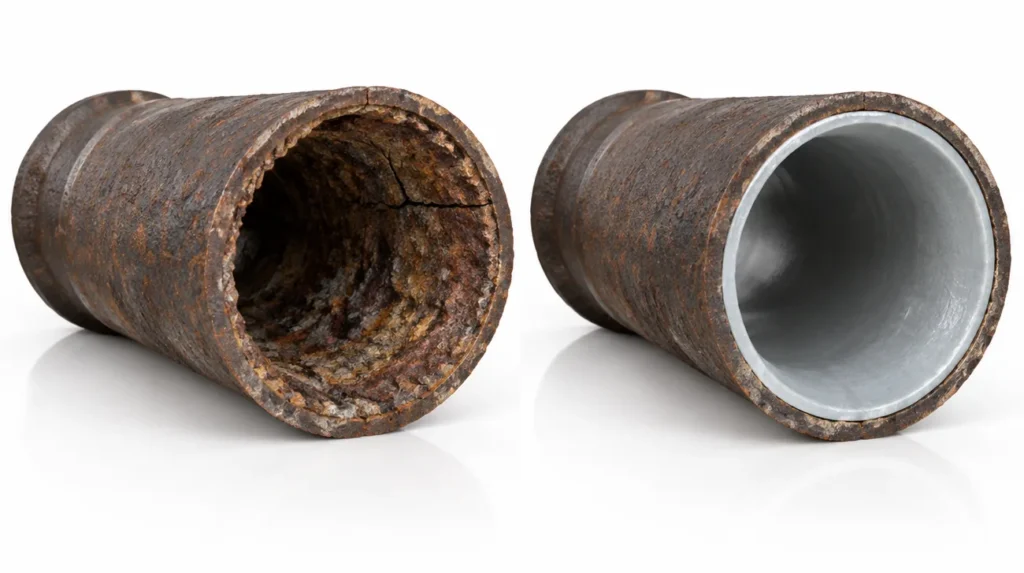
Built for Cave Creek’s large desert lots
On Cave Creek’s custom properties, where homes sit on acreage with mature desert landscaping, horse setups, and long private line runs, an open trench can tear up a lot of ground. Pipe lining rehabilitates the pipe from the inside through one or two small access points. Once the epoxy liner cures, you get a jointless pipe with a 50-year design life, restored flow, and lasting protection against root intrusion and the rocky soil movement common in the foothills, all without disturbing the surface.
What should you do about a main line backup in Cave Creek?
Stop running water in the house, then have the line cleared and put on camera. A backup usually means buildup, roots or a damaged section somewhere along the run, and on Cave Creek acreage that run can be long. Hydro jetting clears the deposit along the full length, and the camera run afterwards shows whether the pipe itself needs repair. On properties with a septic system the tank is separate work; what we clear and repair is the line between the house and the tank.
When does a Cave Creek home need a repipe?
Repiping on a Cave Creek property.
Two things make it different here. The runs are long, because houses sit back on acreage rather than close to the road, so there is simply more pipe involved than in the same job in town. And a good share of properties draw from a well, which means the water reaching the copper has not been through municipal treatment and can carry a heavier mineral load.
Copper thins from the inside under that. Once it is leaking in more than one place the choice is between replacing the system with a whole-house repipe and restoring it where it lies with ePIPE. The first is thorough and disruptive; the second leaves the house intact. Which of the two applies depends on the state of the existing copper, and that is worth establishing before either quote is taken seriously.
The coating goes on inside the pipe already in the walls. The line is cleaned, dried, coated and cured, and it comes back into service with a barrier between the water and the copper rather than a new run of pipe threaded through the house.
Cave Creek sits well north of central Phoenix and plenty of contractors will not come out this far. We do. What we will not do is coat a line that has already thinned past the point of holding one, which is why the pipe gets assessed before the work is booked.
Compare the two routes: ePIPE water line restoration or a whole-house repipe.
Quick Facts for Cave Creek Homeowners
- Many Cave Creek properties run on a well and a septic tank, so the sewer line often runs to a tank instead of a main, and the copper carries untreated well water.
- Sewer and septic runs can be lined from the inside with no trench across the acreage; the tank itself is separate work.
- Leaking copper can be restored in place with ePIPE or replaced with a whole-house repipe, depending on how much sound wall is left.
- Long runs are assessed as a whole, not only where a leak or backup has shown up.
Nearby, we also serve Carefree, Anthem and Scottsdale.
Cave Creek Repipe and Sewer FAQs
Is every property in Cave Creek connected to the Town sewer system?
No. The Town of Cave Creek says its wastewater collection system covers a limited area, and sewer service is primarily available in the core part of town. Property owners who are unsure whether they are connected to municipal sewer should contact the Cave Creek Utilities Department.
Knowing whether a property uses municipal sewer or another wastewater system is important before planning sewer-line repairs.
We are on a well in Cave Creek. Does that change whether the water lines can be restored?
Not the method. It does change what the copper has been through, though. Well water out here is not treated the way a municipal supply is, and a heavier mineral load works on the inside of the pipe at its own pace.
The other difference is length. On acreage the supply runs in and around the house cover more distance than a service line in town, and their condition is not always uniform along the whole of it. That is a reason to have the run assessed as a whole rather than only the stretch where a leak has shown up.
Why does a damaged sewer pipe need to be cleaned before CIPP lining?
CIPP needs a clean, open pathway so the liner can fit properly against the existing pipe.
NASSCO states that the host pipe should be clear of obstructions, crushed sections, and excessive reductions in its opening before CIPP installation. Cleaning followed by camera inspection helps determine whether the pipe is ready for lining.
Pipeliners also uses hydro jetting for buildup removal and preparation before inspection or lining.
Can I continue using my toilets and drains while CIPP lining is being installed?
Usually not during the active lining process.
NASSCO states that wastewater flow must be diverted or bypassed during many CIPP installations. Your contractor should explain when toilets, sinks, showers, and other drains need to remain unused and when normal service can resume.
Does a long sewer line automatically mean trenchless lining cannot be used?
No. CIPP can rehabilitate substantial lengths of pipe, although the practical installation length depends on pipe diameter, bends, access, and configuration.
NASSCO notes that CIPP installation lengths can reach hundreds of feet or more in suitable applications. The actual feasibility of a residential line should be determined after inspection.
Can a heavily scaled or narrowed sewer pipe still be lined?
Possibly, but the restriction normally needs to be addressed first.
Heavy scale, debris, or other buildup can reduce the pipe opening enough to interfere with liner installation. NASSCO identifies significant loss of cross-sectional area as a limitation for CIPP, so cleaning and inspection should come before deciding whether lining is appropriate.
How is a CIPP sewer liner cured inside the pipe?
CIPP liners can be cured using several methods. NASSCO lists ambient curing, heat such as steam or hot water, and photoinitiated curing using UV or LED light.
Pipeliners uses the photoinitiated route, curing with UV LED light rather than ambient time or hot water.
Are Cave Creek restaurants and commercial properties good candidates for trenchless drain repair?
They can be when the damaged pipe is suitable for rehabilitation. Commercial properties may benefit from trenchless work because reducing excavation can also reduce disruption to customers, tenants, and operations.
Cave Creek’s wastewater system serves commercial properties and restaurants, and the Town specifically accounts for grease, oil, and sand interceptor devices within its wastewater-rate structure.
Pipeliners also uses hydro jetting for grease, sludge, debris, and commercial drain maintenance.
How can I tell whether a sewer backup involves my property or the Cave Creek wastewater system?
The location of the blockage needs to be identified.
The Town maintains Cave Creek’s public wastewater collection system and regularly cleans and videos its gravity sewer lines. If the problem appears isolated to your home or business, a private sewer camera inspection can help locate the obstruction or damage. If there are signs of a problem with the public system, contact Cave Creek Utilities.
Does trenchless sewer repair in Cave Creek require a permit?
It may, depending on the work being performed.
Cave Creek’s Building and Fire Code Compliance Division enforces the Town’s plumbing requirements, and as of 2026 the Town uses the 2024 International Plumbing Code. Permit applications and inspections are handled through the Town’s online permitting system.
The contractor should confirm applicable permit and inspection requirements before beginning the project.
